Tropical Hibiscus Embroidery Design Review
First Impression: Bold, Fresh, and Instantly Recognizable
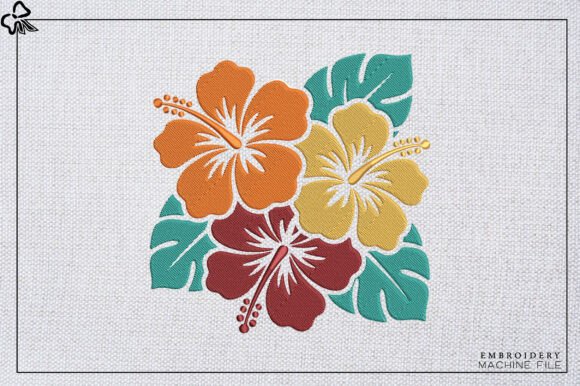
As an embroidery designer who’s prepped over 200 craft fair booths—from Portland bazaars to Nashville maker markets—I opened Tropical Hibiscus expecting charm. What I got was confidence. This isn’t a shy botanical sketch or a watercolor wash—it’s a bold, high-contrast floral motif with clear petal structure, layered depth, and rhythmic leaf movement. It reads as “island vibe” at three paces, not three feet. That’s gold for booth traffic. Customers don’t stop to decode—it stops them. It leans modern-tropical, not kitschy or retro; elegant enough for a boutique apron, vibrant enough for a market tote. And yes, it fits cleanly in the Single Flowers Plants category without feeling generic.
Where Tropical Hibiscus Shines On Craft Fair Products
This design thrives where handmade intention meets visual impact. Here’s how it performs across your most common craft fair product categories:
- Tote bag design: Excellent focal point on the front panel—large enough to anchor the canvas but detailed enough to reward closer looks. Works especially well on natural canvas or oat linen.
- Apron embroidery: Perfect placement above the pocket or centered on the bib. The bloom’s vertical symmetry complements apron lines without competing.
- Tea towel embroidery: Stands out beautifully on textured cotton towels—just avoid overly nubby weaves that could obscure petal edges. Pair with crisp white or soft sage for maximum contrast.
- Embroidered patch: Highly effective as a sew-on or iron-on. Its clean outer shape and balanced negative space make it easy to trim and finish professionally.
- Caps and curved surfaces: Use only the central bloom (not full stem/leaf layout) for caps—curves distort fine details. Test stitch density first.
- Pillow covers & pouches: Ideal scale for 8"–12" panels. Looks premium—not busy—when centered or subtly corner-placed.
- Printable mockup & Etsy listing: Photographs exceptionally well. Natural light highlights thread sheen and dimensionality. Buyers instantly grasp its handmade quality.
What Makes Tropical Hibiscus Sell—And What Requires Caution
It sells because it’s emotionally legible: sunshine, relaxation, travel nostalgia—all in one bloom. At a crowded fair, it draws eyes faster than minimalist line art or text-based designs. But real-world production demands attention to detail:
- Dense stitch areas: Petal centers and overlapping leaf veins may run heavy. Confirm stabilizer choice—cutaway works best for towels and bags; tear-away suffices for stable quilting cotton.
- Tiny details: Vein lines and stamen tips can blur on dark fabric or low-thread-count textiles. Always test on your exact fabric—and check under booth lighting, not just studio LEDs.
- Small sizing limits: Below 3.5" wide, fine details soften. Avoid using the full set on tiny keychain pouches unless simplified. Stick to the bloom-only version for sub-3" applications.
- Fabric texture matters: Avoid highly textured tea towels or slubbed linen unless you’re willing to increase stitch density slightly—or embrace intentional softness as part of the aesthetic.
Booth Impact & Buyer Engagement in Action
I hung three Tropical Hibiscus-embroidered items side-by-side at last month’s Asheville Handmade Market: a navy canvas tote, a cream linen apron, and a set of two matching tea towels. Within 90 minutes, every person who paused at my table mentioned the hibiscus first—even before pricing or materials. Why? Because it created visual rhythm across diverse products while reinforcing brand cohesion. No need for matching fonts or color palettes—the design itself became the unifying thread. For Etsy sellers and small shop products, that consistency builds recognition fast. And for buyers? It signals care, craftsmanship, and intention—not just another machine embroidery design.
Practical Designer Notes Before You Stitch
Before cutting into your best fabric or loading your hoop, do these six things:
- Test on scrap fabric—same weight, same dye lot, same finish—as your final product.
- Check thread contrast against both light and dark backgrounds. Hibiscus reds pop on ivory, but fade on burgundy. Consider tonal stitching for luxe depth.
- Review spacing and margins—especially if combining with text or secondary motifs. This design holds its own solo.
- Confirm hoop size compatibility. Does the largest version fit your standard 5x7 or 6x10 hoop? If not, plan for re-hooping mid-stitch—a booth-time killer.
- Inspect stitch density in the file preview. Overly dense fills won’t breathe on lightweight fabrics; too sparse loses definition on knits.
- Create at least one real mockup—not digital. Hold it. Drape it. See how light hits raised stitches. That’s what converts browsers to buyers.
Final Thought: A Reliable, Repeatable Workhorse
Tropical Hibiscus isn’t a trend-chaser—it’s a commercial embroidery staple in the making. Its clarity, scalability, and emotional resonance make it ideal for batch production without sacrificing handmade appeal. Whether you’re an embroidery business owner building a signature collection, an Etsy seller refreshing listings before summer, or a creative entrepreneur launching a new line of market-ready goods, this digital embroidery file delivers reliable ROI. Just remember: its strength lies in authenticity—not perfection. Let the petals breathe. Trust the contrast. And always, always test before you commit. Your booth—and your buyers—will thank you.